lunes, 3 de septiembre de 2012

Hasta la vista amigos!!

After many years working in this project, we finally have to say goodbye. We, sadly and definitely, have run out of funds to continue the development of gvSIG 3D. We have had very good moments in these years, and we want to thank to all the people involved in this project and the people who helped us along this time.

First of all to Javier Lluch, the director of the project, thanks for being always worried about us and for giving us the oportunity to demostrate our capacities. Also thanks for trying to keep the group as long as possible.

Also to the people of the team who have been part of this project since the beginning. María Ten, Jesús Zarzoso, Leo Salom and Rafa Gaitán: you have been the blood of the project, good luck with your careers!

We also would like to express our gratitude to the entities that collaborated with us along this years: CIT, Iver Technologies, Prodevelop, Deimos, IGN/CNIG and the gvSIG association. 

Finally we want to thank their commitment to José Luis Miñana, Julio Campos, Salva Bayarri, Ángel Fraile, Jorge Piera, Nacho Brodín, Miguel Montesinos, Viqui Agazzi, Jorge Sanz, Fran Peñarrubia, Jesús Palomar, César Martínez, Vicente Caballero, Chevi Higón, Paqui Mercadé, Antonio Rodríguez, Álvaro Anguix, Mario Carrera, Manuel Madrid, Gabi Carrión, Joaquín José del Cerro, César Ordiñana and all the people involved in one way or another in the development of gvSIG 3D.

This blog will be discontinued, but it will remain on the net for the sake of the community. Of course, we will continue giving support as much as we can in the gvsig lists. 

We are now developing other projects, in fact we are inmersed in the development of a new 3D GIS library, in collaboration with Mirage Technologies, called mworld3D geared towards mobile environments. It will run in Android and iOS devices as well as in desktop environments.

Our final words must go to the gvSIG community, please keep growing and stay resilient, thanks for being there. 
 
Hasta la vista amigos!!!

Jordi Torres.

The gvSIG 3D team

martes, 10 de julio de 2012

A multiresolution tool and a personal goodbye

In this post we´d like to show a short tutorial on how to use the new multiresolution tool that is included in the latest build of the 3D extension for gvSIG 2.0. We can see how working with a huge dataset of points can be very taxing for the performance, making the system unresponsive and difficult to work. This new tool allows us to massively improve the performance with a very small hit on visual quality. We hope this tool can be useful for you!


I´d like to use this post also as a personal goodbye. It´s been a fantastic time here working in the AI2. Who´d had said I´d be working here for so long when I joined the team as an intern to work on my Final Project 5!! years ago?
Time passes quickly and now it´s the moment to move on and try new challenges. Here I have worked with an amazing group of people and I´d like to have some words for each of them:

-Rafa Gaitan, you are probably the most talented person I´ve had the chance to meet. As a boss, you´ve been always very helpful and understanding, knowing how to get the best of all of us. I´ll never thank you enough for the countless times you have helped me to solve problems in a matter of minutes that it´d taken me days.

-Jordi Torres, you had a tough job when you inherited Rafa´s position within the team, but you knew how to keep the unity in the team and have become a brilliant team leader in the end. I really appreciate the hard work you have been doing to keep this boat afloat in this difficult moments. The group is in good hands as long as you´re there.

-Maria Ten: You were the first to leave us some months ago, but even so, whenever we have needed your help you´ll find the time for it. I know it must´ve been a little hard to be the only girl around here, even if you won´t admit it. It was a pleasure to work with you!

-Leonardo Salom: We have never worked in the same project, but we´ve shared each other´s successes and frustrations. I want to thank your support in the difficult moments, as you´ve always been there.

-Javier Lluch: Thanks for giving me the oportunity to work here and thanks for trying to keep the group as long as has been possible. Congratulations for your new job!

-Jorge Izquierdo: The last to arrive and altough we haven´t worked in the same project, I enjoyed our conversations about technology, videogames, etc (politics not so much, hehehe) I think you are very capable person, with the right attitude you´ll do great.

I´d like to mention too some people from the AI2 with whom I´ve had very good moments; Enrique Medina, David Anes, Eduard Martorell, Joan Blasco, Marcos Martí, Oscar Ripollés and José Luis Hidalgo.

To end this post, I´d like to say that even thougth I leave this job, I´ve been assigned as Mantainer of the 3D Extension for gvSIG 2.0, so I´ll still be part of the gvSIG project for the time being.

Good bye everyone and keep the good job!

viernes, 22 de junio de 2012

New build of gvSIG 3D (number 1) for gvSIG 2.0 -- Codename "TITANIC"


We are pleased to announce a new build of gvSIG3D for gvSIG 2.0, available in [1]. You can download the package and install it from the addons manager. This version is ready to work with build 2048 of gvSIG 2.0 and probably with future builds.

This development has been possible thanks to Prodevelop and  the project España Virtual.

This time we'd like to thank to Miguel Montesinos, Nacho Brodín, and Viqui Agazzi. They walked with us this path.

But specially I want to remark the great work of Jesús Zarzoso, developer in charge of merging the code between osgVirtualPlanets and gvSIG. Well done Jesús!!
 
Among the new features, we shall emphasize:
* Big refactor of osgVirtualPlanets, the core of gvSIG 3D.
* 3D extension code from scratch.
* Lidar reading support (.las).
* Citygml reading support (.citygml)(see the video).
* Multiresolution capacities ( see the video ).
* New 3D symbology framework (see the video).
* New render system using shaders and avoiding the fixed pipeline. (see the video)
* netCDF raster and vectorial support. (see the video)
* Tile raster cache integration with gvSIG -raster libraries.

These development versions are oriented to test and evaluate new functionalities of gvSIG, so it's not recommended to use it in a production environment. Please consider that it is an alpha release so don't expect it to be very stable.

[1]https://devel.gvsig.org/download/projects/3d/pool/org.gvsig.gvsig3d.app.extension/

jueves, 26 de abril de 2012

gvSIG 3D Training Course in Valencia

Hi all,

We will be teaching a gvSIG advanced course next month of June. It will be held in the Politechnical University of Valencia. The topics are Sextante, 3D  and animation extension.

It will be in spanish and in collaboration with professor Jesús Palomar from EdugvSIG blog.

You can see all the information here:

http://www.cfp.upv.es/formacion-permanente/cursos/gvsig-avanzado--geoprocesamiento-y-visualizacion-con-sextante-y-gvsig-3d_idiomaes-menuupvtrue-cid30303.html

Cheers.

miércoles, 7 de marzo de 2012

Massive LiDAR data in gvSIG 3D!!!

Hi all,

This is the last video we did for España Virtual Workshop. It shows gvSIG 3D and osgVirtualPlanets drawing massive vectorial data without losing render performance using multiresolution and memory pagination techniques.

This work has been done in the scope of the Ph.D. thesis of Rafa Gaitán, so a lot of kudos to him!! The video speaks for itself...

miércoles, 29 de febrero de 2012

improvements in 3D symbology

Hi Community,

Following video shows the improvements we are doing in symbology for gvSIG 3D in gvSIG 2.0 series. We added a new symbology panel (still in development) for 3D symbols. Now you can symbolize your layers with simple markers, picture markers, 3D objects and particle systems... :)

These advances came with "España Virtual" Project, and right now we are working towards an alpha release of the 3D extension for gvSIG 2.0.

viernes, 17 de febrero de 2012

Last workshop of "España Virtual" project

Hi all,

We just came back from the last workshop of "España Virtual" CENIT project. It was held at IGN (Instituto Geográfico Nacional) headquarters in Madrid. We saw very interesting and high-level presentations from the members of this project, and we tried to do our best in our turn showing our last developments... :).

We were glad to see gvSIG and specially gvSIG 3D being used in very different scenarios, from scientific visualization to building representations.

From this blog we want to thank all this people (administration, companies and universities) for making this project possible and for pushing gvSIG and gvSIG 3D.

We'd like to thank to Prodevelop for trusting us in this adventure. Specially to Nacho Brodín, Viqui Agazzi and Miguel Montesinos. Also thanks to the people of Deimos for their patience and their great work coordinating this project (specially to Jorge Blanco, Miguel Lizondo and Carlos Fernandez).

We will show some of the work done in the scope of this project in future posts.


jueves, 9 de febrero de 2012

Improvements in elevation layers

Hi community,

This new video shows the new system to load elevation layers and how osgVirtualPlanets deal with overlapping layers. Before this change gvSIG 3D (gvSIG 1.x series) cannot show the overlapping zones and the rendering was done using fixed pipeline, now (gvSIG 3D for gvSIG 2.0 series) this areas are merged in realtime in a terrain shader.

There are changes in lighting calculation that give the 3D view smooth shading feeling and a better appearance.

We'd like to thank to Maria Ten for her work, and we wish she feels great in her new job.
Thank you and good luck Maria!!! ... :)

viernes, 3 de febrero de 2012

Loading netCDF Files in gvSIG 3D (for gvSIG 2.0 series)

Hi all,

We are very busy preparing an upcoming Workshop for España Virtual project, but we think it could be interesting to show to you these new features: loading raster and vectorial netCDF files.

This work has been done with the kindly help of Nacho Brodín and Jorge Piera, both from Prodevelop. Thank you guys!!

First video shows gvSIG 3D loading a raster netCDF file and working with it.


The second one shows a ship travel vectorial netCDF file, and how to apply a time filter.


Sorry for this short explanation, more videos are coming soon!

miércoles, 14 de diciembre de 2011

AI2 3D Viz group capabilities

Hi all,

Here we are after the 7th International gvSIG Conference. We were glad to see the interest demonstrated by the audience to our seminar.

We are very grateful to the project España Virtual, Prodevelop, CNIG and the gvSIG association for their support so far. But now the ai2 team is in trouble due to the lack of funding. As you probably know, the downturn has a very negative impact on R&D teams. We want to continue developing gvSIG 3D, osgVirtualPlanets and any new challenges proposed.
 
The following video shows the capabilities of our team. Some of the features showcased in the video have been developed in the scope of gvSIG 3D. Others are prototypes or research projects we are working on. Our expertise is in 3D GIS visualization for desktop and mobile environments, also in OpenSceneGraph. So if you are interested in contributing in any manner contact us.

Enjoy the video and switch on your speakers!

jueves, 10 de noviembre de 2011

Animation video tutorial

Hi all!

This time we want to share a contribution from Mario Carrera, from the gvSIG team. It explains how to make an animation with the animation extension. He is kindly explaining 3D extension on meetings and conferences where we are not able to be. Thanks for that too Mario :) . 

As you know, we are near the 7th International gvSIG Conference and the ai2 team will be there talking about 3D extension. We will post soon about the contents here and in the gvSIG Blog.

Check the gvSIG videos section and the gvSIG3D youtube channel  for more tutorials!


martes, 13 de septiembre de 2011

cityGML patch for windows

Hi again!

Here it is the patch for windows. As we said in the previous post the implementation is based on the library libcitygml[1]. This open source project is still in development and we'd like to thank to Joachim Pouderoux (the main developer) for his kindly help. 

The work is in progress, but we think it is a good moment to let the community to test this new feature. The patch is now available for linux and windows. The instructions to install it in windows are the following -also available in a README.txt file- (see [2] to install in linux):
  1. Download the file for your Operating System from[3]. 
  2. Make sure you have installed gvSIG-1.11[4] and the final release of 3D extension[5].   
  3. Unzip the patch into a temporal directory.
  4. Copy bin directory into your gvSIG installation directory,  usually located at: C:\Program Files\gvSIG_1.X.X\
  5. 3) Copy the content of Java directory into your current Java VM directory: 
    C:\Program Files\Java\jre1.6.0.X\
  6. Run gvSIG 1.11 and follow the videotutorial[2]
Important note: If you have different Java VM installed in your system 
you can check if the folder jre1.X.X/bin has a subfolder called osgPlugins-2.8.3 
to check the correct version (the one used by gvSIG and the 3D extension). 
In addition, some windows systems need administrator privileges to overwrite this files.

[1]http://code.google.com/p/libcitygml/
[2]http://gvsig3d.blogspot.com/2011/09/patch-to-load-citygml-models-in-gvsig.html
[3]http://www2.ai2.upv.es/difusion/gvsig3d/citygml_patch/
[4]http://www.gvsig.org/web/projects/gvsig-desktop/official/gvsig-1.11/downloads
[5]http://www.gvsig.org/web/projects/gvsig-desktop/official/gvsig-1.10/extensiones-gvsig-1.10/extension-3d/downloads

viernes, 9 de septiembre de 2011

Patch to load cityGML models in gvSIG 1.11 + 3D extension

Hi community!

We are working again after a great holydays. This time we want to share with you our advances in the scope of the Project "España Virtual". For this reason we have done a backport for gvSIG 1.11 of a new feature we are working on: to load cityGML models.

The implementation is based on the library libcitygml[1]. This open source project is still in development and we'd like to thank to Joachim Pouderoux (the main developer) for his kindly help. 

The work is in progress, but we think it is a good moment to let the community to test this new feature. The patch is only available for linux (we expect to upload the patch for windows in a few days) and the instructions to install it are very simple:
  1. Download the file for your Operating System from[2]. 
  2. Make sure you have installed gvSIG-1.11[3] and the final release of 3D extension[4].  
  3. Extract the compressed file in the folder you installed gvSIG-1.11, overwriting the folders bin and libs.
  4. Run gvSIG 1.11 and follow the next video tutorial! :)


Important note: cityGML files must be renamed as .citygml, otherwise the osg loader won't be able to load the models.

[1]http://code.google.com/p/libcitygml/
[2]http://www2.ai2.upv.es/difusion/gvsig3d/citygml_patch/
[3]http://www.gvsig.org/web/projects/gvsig-desktop/official/gvsig-1.11/downloads
[4]http://www.gvsig.org/web/projects/gvsig-desktop/official/gvsig-1.10/extensiones-gvsig-1.10/extension-3d/downloads

viernes, 29 de julio de 2011

WIP: 3D extension on gvSIG 2.0

Hi all!

Just before the gvSIG 3D team goes away on vacations, we'd like to show you a sample of one line of work that has been in development for the last few months. Since the release of gvSIG 2.0 is getting closer, we decided to start the process of adapting gvSIG 3D to this new version in the scope of the España Virtual project.

As some of you may know, gvSIG 2.0 is not just an iteration of the 1.x branch, therefore changes have been made to the core of the application that doesn't make the task of porting our extension a trivial job.
In this post we would like to make a little summary of the tasks that have been already finished, and those that are still in development.

Finished tasks:
  • Adapted the building system and dependencies.
  • Changed the projects architecture to match the gvSIG 2.0 requirements.
  • Document View3D available from the Project Manager. Creates and customizes spherical and flat planet views.
  • Loading of raster and rasterized vectorial layers.
  • Integration of the gvSIG 3D tools. Navigation modes, stereo and fullscreen visualization, etc.
In progress:
  • Adapt the extension to work with osgVP 3.0.
  • Use the cache system of the new raster libraries.
  • Analyze and integrate the new symbology framework from osgVP and gvSIG.
  • Modify the persistence mechanism to match the new requirements.
  • Integrate the load and edition of OSG layers.


Finally, in the next video, you can see gvSIG 3D running on top of the latest build (2030) of gvSIG 2.0.


Keep in mind that the status of the project is still of early alpha, therefore there isn't a binary distribution to download yet.

miércoles, 6 de julio de 2011

Coming soon: PostGIS 3D!!

Hi all,

We are really happy to announce this new feature. A part form being a nice improvement it has something special... it comes from the community!

The author of the patch is Jose Carlos Martinez-LLario from DICGF at UPV. He is very skilled in spatial database development, in fact he owns a very promising project called JASPA. We have to mention Fran Peñarrubia and Nicklas Aven, they helped too in testing and integration of the patch.

So...Thank you very much guys!

The patch is already commited in the trunk of gvSIG 1.1x and it will be available in gvSIG 1.12 version. This patch does not change anything in gvSIG 3D, the changes are applied to the core of gvSIG so the same version of 3D extension (codename "BladeRunner") should work with postGIS 3D.

Next video is a demo of postGIS 3D running in gvSIG 3D. We'll do some tutorial when gvSIG 1.12 becomes available. 

miércoles, 29 de junio de 2011

OpenSceneGraph-3.0.0 released!

Hi all!

A new version of OpenSceneGraph (OSG) has been released. OSG is the standard scenegraph for OpenGL Applications and we are using it extensively in our core library OSGVirtualPlanets (osgVP). We are proud to be contributors of OSG, and our last contribution was to add Android support to the library. Next releases of OSGVirtualPlanets will be built against OSG 3.0.0.

From here we'd like to thank the work done by the whole OSG community and specially to Robert Osfield, the leader of the library. 
 
FYI this is the OSG 3.0 Press Release: 

OpenSceneGraph 3.0 release adds support OpenGL ES 1.1, OpenGL ES 2.0, OpenGL 3.x to 4.0, support for Android and IOS platforms and much more

PERTHSHIRE, Scotland - 28th June 2011 - OpenSceneGraph Professional Services announces the release of OpenSceneGraph 3.0, the industry's leading open-source scene graph technology, designed to accelerate application development and improve 3D graphics performance. OpenSceneGraph 3.0 written entirely in Standard C++ and built upon OpenGL, offers developers working in the visual simulation, game development, virtual reality, scientific visualization and modeling markets - a real-time visualization tool which eclipses commercial scene graph toolkits in functionality, stability and performance. OpenSceneGraph 3.0 runs on all Microsoft Windows platforms, Apple OS/X, IOS, GNU/Linux, Android, IRIX, Solaris, HP-UX, AIX and FreeBSD operating systems.

Open-source development delivers industry-leading features and performance

The OpenSceneGraph 3.0 release is the culmination of 12 years of work by the lead developers and the open-source community that has grown up around the project. The real-time graphics industry and academia embraced it from the very beginning, deploying it in real-world applications, and actively participating in its development, testing and refinement. The end result is a high-quality library with a feature set relevant to application developers' needs.

Updates include:

  • OpenGL ES 1.1, and OpenGL ES 2.0 support
  • OpenGL 3.x and 4.x support along with associated OpenGL extensions
  • Support for Android on tablets and phones
  • Support for IOS on tablets and phones (end users applications have already been accepted on the App Store)
  • New extensible serializers that provide new .osgb binary, .osgt ascii and .osgx xml file native formats
  • New generalized serializable metadata architecture
  • New osgQt library that makes it straight forward to integrate OpenSceneGraph with Qt
  • new FBX plugin
  • Improvements to osgVolume enabling high quality race traced volume rendering
  • Improvements to osgManipulator making it more flexible
  • Support for Cocoa and 64bit OSX build
  • Improved thread safety and efficiency of database paging
  • New Texture and buffer object pools for efficiently managing GL object resources

Downloads and Licensing

OpenSceneGraph is open-source, so full source code is provided, and can be copied, modified and used free of charge for commercial and non-commercial use. Access to the source allows end users greater flexibility in how they develop, debug and deploy their applications. They gain productivity and freedom by being able to leverage the tool chain in accordance with their own release cycles. Downloads of binaries and source can be found in the Downloads section of the openscenegraph.org website.
OpenSceneGraph is released under the OpenSceneGraph Public License, which is based on the Lesser GNU Public License (LGPL), permitting the software to be used free of charge across the full spectrum of commercial and open-source applications. Furthermore, it allows both static and dynamic linking of the OpenSceneGraph libraries without restricting the licensing of the user's software.

OpenSceneGraph Books now available

The new book dedicated to the OpenSceneGraph 3.0 is now available https://www.packtpub.com/openscenegraph-3-0-beginners-guide/book.

Professional support and services

OpenSceneGraph project is backed up with professional services by OpenSceneGraph Professional Services, based in Scotland, and Skew-Matrix and AlphaPixel both based in the USA, and a range of Contractors from around the world. Services available include:
  • Confidential Professional Support
  • Bespoke development
  • Consultancy
  • Training

Community support and contribution

The diverse and growing community of over 5000 developers is centred around the public osg-users mailing list/forum, where members discuss how best to use OpenSceneGraph, provide mutual support, and coordinate development of new features and bug fixes. Members of this community come from many different countries with backgrounds ranging from some of the world's largest aerospace companies, game companies, and visual simulation specialists to university researchers, students and hobbyists.
The OpenSceneGraph project owes a great deal to the community for its development and support, in particular we wish to thank the 464 individuals from around the world that have directly contributed to the development and refinement of the OpenSceneGraph code base.

viernes, 3 de junio de 2011

Some developments using gvSIG 3D in "España Virtual"

English

There are several I+D teams working with gvSIG 3D in the scope of "España Virtual" project, a CENIT project supported by CDTI[1].  Their works are very interesting, and we were able to see some of them at last EV workshop. We asked them for permission to show what are they doing with gvSIG 3D. So we would like to thank to the following enterprises: Deimos[2], Indra[3] and Telefónica I+D[4]. In addition we'd like to thank to the following institutions and universities: Polytechnical University of Madrid(UPM)[5], the Institute of applied computing and community code(iac3)[6] from the University of the Balearic Islands.

The developments of this people are quite technical so forgive me in the case anything is not correct.

The first two images (from iac3) we show are related to 3D geovisualization of physicall phenomenon in a given time. We hope we can see this effects in 4D in the near future! 

Español

Hay varios equipos utilizando gvSIG 3D en el ámbito del proyecto España Virtual, un proyecto CENIT iniciativa del CDTI[1]. Sus trabajos son muy interesantes, y pudimos ver algunos de ellos el el último workshop de EV. Les hemos pedido permiso para enseñar en este blog lo que están haciendo con gvSIG 3D. Así que queremos agradecer a las empresas Deimos[2], Indra[3], y Telefónica I+D[4], y también a la Universidad Politécnica de Madrid(UPM)[5], al Institute of applied computing and community code (iac3)[6] de la Universitat de les Illes Balears que nos permitan mostrar estas imágenes.

Estos trabajos son muy técnicos, así que pido disculpas por adelantado si algo de lo escrito no es correcto.

Las primeras dos imágenes (cedidas por iac3) tienen que ver con la geovisualización tridimensional de fenómenos físicos. Esperamos poder ver estos efectos en 4D en un futuro cercano!


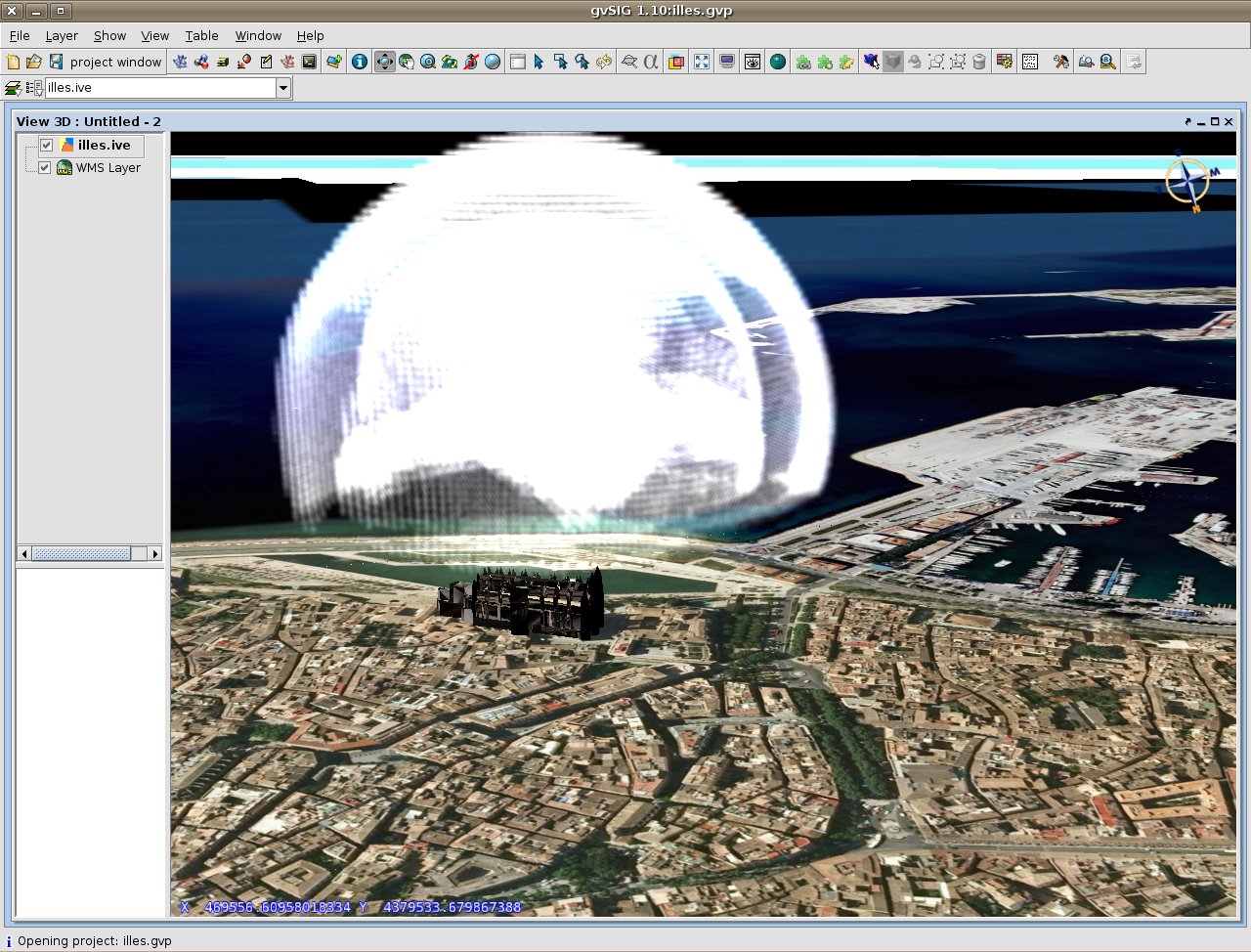
In the other hand Indra and UPM are working on building visualization and 3D visualization of athmospheric patterns related to air quality. They gave us this images. Every single 3D data is represented by a sphere, which color depends on the value of the data. 

Por otro lado Indra y la UPM están trabajando en la representación tridimensional de edificios y la visualización de datos 3D producidos por modelos atmosféricos y de calidad del aire. En este caso cada dato 3D viene representado por una esfera, cuyo color varia dependiendo del valor del dato. Nos han dado permiso para mostrar estas imágenes:


[1]http://www.cdti.es
[2]http://www.deimos-space.com
[3]http://www.indracompany.com/
[4]http://www.tid.es/
[5]http://www.upm.es/
[6]http://www.iac3.eu/

sábado, 14 de mayo de 2011

gvSIG 3D Team at "España Virtual" Workshop

English

This week we have been very busy attending to the "España Virtual" Workshop[1]. As many of you know this CENIT project supported by CDTI[2] and leaded by Deimos-Space[3], aims to push the state of the art of geomatic science in Spain. In the scope of this project we are developing hard in several lines of work. In this post you will be able to see a few videos of some of them.
  • Advanced Symbology: We added new render techniques to the osgVirtualPlanets library[4], the core of gvSIG 3D. These techniques let us to render new symbols with a quite good frame rate. In this video we show point sprites, particle systems and instanced rendering. We hope we can integrate these functionalities soon in gvSIG 3D. 
  • Multiresolution of vectorial data: One of the problems we have in the current version of gvSIG 3D is rendering big amount of vectorial data. Is a must to apply multiresolution techniques in order to avoid RAM memory problems and low frame rates.  This video shows a quite popular spatialization algorithm called Octree.  It could be very useful to render regular massive vectorial data, for example Lidar data.
  • Collaboration with a friend project, WebGLEarth[5] : This project enables exploration, zooming and “playing” with the globe in any web browser on any platform supporting webGL (like chrome 9[6] or firefox 4[7]). We are collaborating with them and we have implemented zoom and pan controls, and camera throwing. It is a very promising project.

Español

Esta semana hemos estado en el workshop del proyecto "España Virtual"[1]. Como muchos de vosotros sabeis, este proyecto CENIT iniciativa del CDTI[2] y liderado por Deimos-Space[3] pretende avanzar el estado del arte en el campo de la geomática en España. En el ámbito de este proyecto estamos trabajando duro en varias líneas. En este post podreis ver videos de algunas de ellas.
  • Simbología avanzada: Estamos trabajando en añadir nuevas técnicas de visualización en la librería osgVirtualPlanets[4], el núcleo de gvSIG 3D. Estas técnicas nos permitirán mejorar el tiempo de dibujado y añadir nuevos tipos de símbolos. En este video se muestran point sprites, sistemas de partículas e instanciación de geometría. Esperamos poder integrar estas funcionalidades pronto en gvSIG 3D. 
  • Multirresolución de datos vectoriales: uno de los problemas que tenemos en la actual versión de gvSIG 3D es visualizar grandes cantidades de información vectorial. Se deben aplicar algoritmos multirresolución para evitar problemas de visualización y memoria. En este video se muestra una técnica de espacialización de geometría bastante conocida, el Octree. Puede ser muy útil a la hora de representar cantidades masivas de datos vectoriales regulares, como por ejemplo los datos Lidar.
  • Colaboración con un proyecto amigo, WebGLEarth[5]: Este proyecto permite la visualización e interacción con un globo virtual en cualquier navegador y plataforma que soporte webGL (como chrome 9[6] o Firefox 4[7]). Nuestra colaboración hasta el momento ha consistido en la implementación de los controles de movimiento y el lanzamiento de cámara.


[1]http://www.españavirtual.org
[2]http://www.cdti.es
[3]http://www.deimos-space.com
[4]http://forge.osor.eu/projects/osgvp
[5]http://www.webglearth.org
[6]http://google.com/chrome
[7]http://www.mozilla.com/firefox/fx/

viernes, 1 de abril de 2011

gvSIG 3D - Final Version - codename "BladeRunner"!!


Español 

Hola replicantes ;) !!

Hoy es un día especial para nosotros...Después de cinco años de trabajo nos complace anunciaros la publicación de la versión final de gvSIG 3D disponible en [1]. También hemos publicado una versión para Mac OSX que incluye 3D disponible en [2].

Queremos agradecer toda la colaboración que hemos recibido de la comunidad de usuarios, cuya implicación en la fase de testing ha sido inmejorable y que incluso ha elegido el codename "BladeRunner" en una ajustada votación, curiosamente el nombre propuesto por el jefe... ;)

En esta ocasión también nos gustaría agradecer su trabajo a las personas que empezaron con nosotros este proyecto, en especial a Julio Campos, Ángel Fraile y Salvador Bayarri. También a Thibault Mousset y Eline Lachat, que nos acompañaron en un tramo del camino.

En mi ya larga trayectoria en la universidad, tengo que decir que una de las cosas de las que más orgulloso me siento, es de haber formado este grupo de trabajo, el cual demuestra día a día su capacidad de resolver todos los problemas que se les plantean. A pesar de todos los inconvenientes, en cuanto a financiación e incertidumbres que han surgido a  lo largo de este tiempo, el equipo ha sabido permanecer unido y ha hecho frente a todos los inconvenientes. Rafa, Jordi, María, Jesús, Leo y Jorge muchas gracias por vuestro trabajo.

A partir de este momento miramos de cara al futuro con la intención de seguir trabajando duro. Esperamos dar lo mejor de nosotros para que el proyecto mejore día a día.

Por último, también queremos agradecer a la Consellería de Infraestructuras y Transporte, en especial a Martín García y Gabriel Carrión,  por haber creído en nuestro potencial para el desarrollo de este proyecto y por extensión a toda la Asociación gvSIG.

Xavi Lluch

Responsable científico del proyecto y del Grupo de Informática Gráfica del Instituto de Automática e Informática Industrial.

English

Hi replicants ;) !!

Today is a special day for us... After five years of work we are glad to announce the release of the final version of gvSIG 3D!! It is available in [1], and the Mac OSX version in [2].

We appreciate the support provided by the user community, whose implication in the testing process has been extremely important. They also have chosen the codename "BladeRunner" in a very tight voting.

This time we'd also like to thank the people who started this project with us , specially to Julio Campos, Angel Fraile and Salvador Bayarri, as well as Thibault Mousset and Eline Lachat.  

One of the things that made me feel most proud of during my years in the university, has been starting this working group. Their members demonstrate day after day their capacity to solve problems. Despite the difficulties we had (mainly about financiation and uncertainty), the team remained very close: Rafa, Jordi, María, Jesús, Leo and Jorge thank you very much for your work.

From this moment we are looking to the future with the purpose of keep working hard. We hope to do our best in order to improve the project.

We'd like to thank the  "Consellería de Infraestructuras y Transporte", specially  Martín García and Gabriel Carrión, and also gvSIG Association for believing in our potential to develop this project. 

Xavi LLuch

Scientific project manager and Computer Graphics leader in the Instituto de Automática e Informática Industrial.


[1]http://forge.osor.eu/frs/?group_id=178&release_id=746
[2]http://forge.osor.eu/frs/download.php/1556/gvSIG-3D-1_11_0-RC1-1303mac-i586.dmg


viernes, 11 de marzo de 2011

gvSIG 3D - RC1 is here!!


Hola comunidad!

Tras pasar el plan de pruebas y arreglar los fallos encontrados por el equipo de testing estamos más que contentos de poder anunciar la versión RC1 de gvSIG 3D. Podeis descargarla desde aquí [1]. 

En esta ocasión nos gustaría dar las gracias en especial al equipo de testing de gvSIG. También a Álvaro Anguix por ayudarnos con temas no relacionados con el desarrollo, y a Joaquín José del Cerro, por sus acertados consejos.

Si no se encuentran errores graves ésta pasará a ser la versión final!

Por cierto, acordaos de votar en la encuesta para el codename de la versión final. La votación está más que ajustada!!

Hi community!

We are very happy to announce the RC1 version for gvSIG 3D available in [1].  

This time we'd like to thank specially the gvSIG testing team. Also to Álvaro Anguix, for helping us with non-development related stuff, and to Joaquín José del Cerro for his suggestions.

If there aren't critical errors we will tag this version as final!

By the way, we want to encourage you to vote for the final version codename in the poll, just at the right column of this blog. Right now the voting is very tight! 


[1]http://forge.osor.eu/frs/?group_id=178&release_id=718