miércoles, 29 de junio de 2011

OpenSceneGraph-3.0.0 released!

Hi all!

A new version of OpenSceneGraph (OSG) has been released. OSG is the standard scenegraph for OpenGL Applications and we are using it extensively in our core library OSGVirtualPlanets (osgVP). We are proud to be contributors of OSG, and our last contribution was to add Android support to the library. Next releases of OSGVirtualPlanets will be built against OSG 3.0.0.

From here we'd like to thank the work done by the whole OSG community and specially to Robert Osfield, the leader of the library. 
 
FYI this is the OSG 3.0 Press Release: 

OpenSceneGraph 3.0 release adds support OpenGL ES 1.1, OpenGL ES 2.0, OpenGL 3.x to 4.0, support for Android and IOS platforms and much more

PERTHSHIRE, Scotland - 28th June 2011 - OpenSceneGraph Professional Services announces the release of OpenSceneGraph 3.0, the industry's leading open-source scene graph technology, designed to accelerate application development and improve 3D graphics performance. OpenSceneGraph 3.0 written entirely in Standard C++ and built upon OpenGL, offers developers working in the visual simulation, game development, virtual reality, scientific visualization and modeling markets - a real-time visualization tool which eclipses commercial scene graph toolkits in functionality, stability and performance. OpenSceneGraph 3.0 runs on all Microsoft Windows platforms, Apple OS/X, IOS, GNU/Linux, Android, IRIX, Solaris, HP-UX, AIX and FreeBSD operating systems.

Open-source development delivers industry-leading features and performance

The OpenSceneGraph 3.0 release is the culmination of 12 years of work by the lead developers and the open-source community that has grown up around the project. The real-time graphics industry and academia embraced it from the very beginning, deploying it in real-world applications, and actively participating in its development, testing and refinement. The end result is a high-quality library with a feature set relevant to application developers' needs.

Updates include:

  • OpenGL ES 1.1, and OpenGL ES 2.0 support
  • OpenGL 3.x and 4.x support along with associated OpenGL extensions
  • Support for Android on tablets and phones
  • Support for IOS on tablets and phones (end users applications have already been accepted on the App Store)
  • New extensible serializers that provide new .osgb binary, .osgt ascii and .osgx xml file native formats
  • New generalized serializable metadata architecture
  • New osgQt library that makes it straight forward to integrate OpenSceneGraph with Qt
  • new FBX plugin
  • Improvements to osgVolume enabling high quality race traced volume rendering
  • Improvements to osgManipulator making it more flexible
  • Support for Cocoa and 64bit OSX build
  • Improved thread safety and efficiency of database paging
  • New Texture and buffer object pools for efficiently managing GL object resources

Downloads and Licensing

OpenSceneGraph is open-source, so full source code is provided, and can be copied, modified and used free of charge for commercial and non-commercial use. Access to the source allows end users greater flexibility in how they develop, debug and deploy their applications. They gain productivity and freedom by being able to leverage the tool chain in accordance with their own release cycles. Downloads of binaries and source can be found in the Downloads section of the openscenegraph.org website.
OpenSceneGraph is released under the OpenSceneGraph Public License, which is based on the Lesser GNU Public License (LGPL), permitting the software to be used free of charge across the full spectrum of commercial and open-source applications. Furthermore, it allows both static and dynamic linking of the OpenSceneGraph libraries without restricting the licensing of the user's software.

OpenSceneGraph Books now available

The new book dedicated to the OpenSceneGraph 3.0 is now available https://www.packtpub.com/openscenegraph-3-0-beginners-guide/book.

Professional support and services

OpenSceneGraph project is backed up with professional services by OpenSceneGraph Professional Services, based in Scotland, and Skew-Matrix and AlphaPixel both based in the USA, and a range of Contractors from around the world. Services available include:
  • Confidential Professional Support
  • Bespoke development
  • Consultancy
  • Training

Community support and contribution

The diverse and growing community of over 5000 developers is centred around the public osg-users mailing list/forum, where members discuss how best to use OpenSceneGraph, provide mutual support, and coordinate development of new features and bug fixes. Members of this community come from many different countries with backgrounds ranging from some of the world's largest aerospace companies, game companies, and visual simulation specialists to university researchers, students and hobbyists.
The OpenSceneGraph project owes a great deal to the community for its development and support, in particular we wish to thank the 464 individuals from around the world that have directly contributed to the development and refinement of the OpenSceneGraph code base.

viernes, 3 de junio de 2011

Some developments using gvSIG 3D in "España Virtual"

English

There are several I+D teams working with gvSIG 3D in the scope of "España Virtual" project, a CENIT project supported by CDTI[1].  Their works are very interesting, and we were able to see some of them at last EV workshop. We asked them for permission to show what are they doing with gvSIG 3D. So we would like to thank to the following enterprises: Deimos[2], Indra[3] and Telefónica I+D[4]. In addition we'd like to thank to the following institutions and universities: Polytechnical University of Madrid(UPM)[5], the Institute of applied computing and community code(iac3)[6] from the University of the Balearic Islands.

The developments of this people are quite technical so forgive me in the case anything is not correct.

The first two images (from iac3) we show are related to 3D geovisualization of physicall phenomenon in a given time. We hope we can see this effects in 4D in the near future! 

Español

Hay varios equipos utilizando gvSIG 3D en el ámbito del proyecto España Virtual, un proyecto CENIT iniciativa del CDTI[1]. Sus trabajos son muy interesantes, y pudimos ver algunos de ellos el el último workshop de EV. Les hemos pedido permiso para enseñar en este blog lo que están haciendo con gvSIG 3D. Así que queremos agradecer a las empresas Deimos[2], Indra[3], y Telefónica I+D[4], y también a la Universidad Politécnica de Madrid(UPM)[5], al Institute of applied computing and community code (iac3)[6] de la Universitat de les Illes Balears que nos permitan mostrar estas imágenes.

Estos trabajos son muy técnicos, así que pido disculpas por adelantado si algo de lo escrito no es correcto.

Las primeras dos imágenes (cedidas por iac3) tienen que ver con la geovisualización tridimensional de fenómenos físicos. Esperamos poder ver estos efectos en 4D en un futuro cercano!


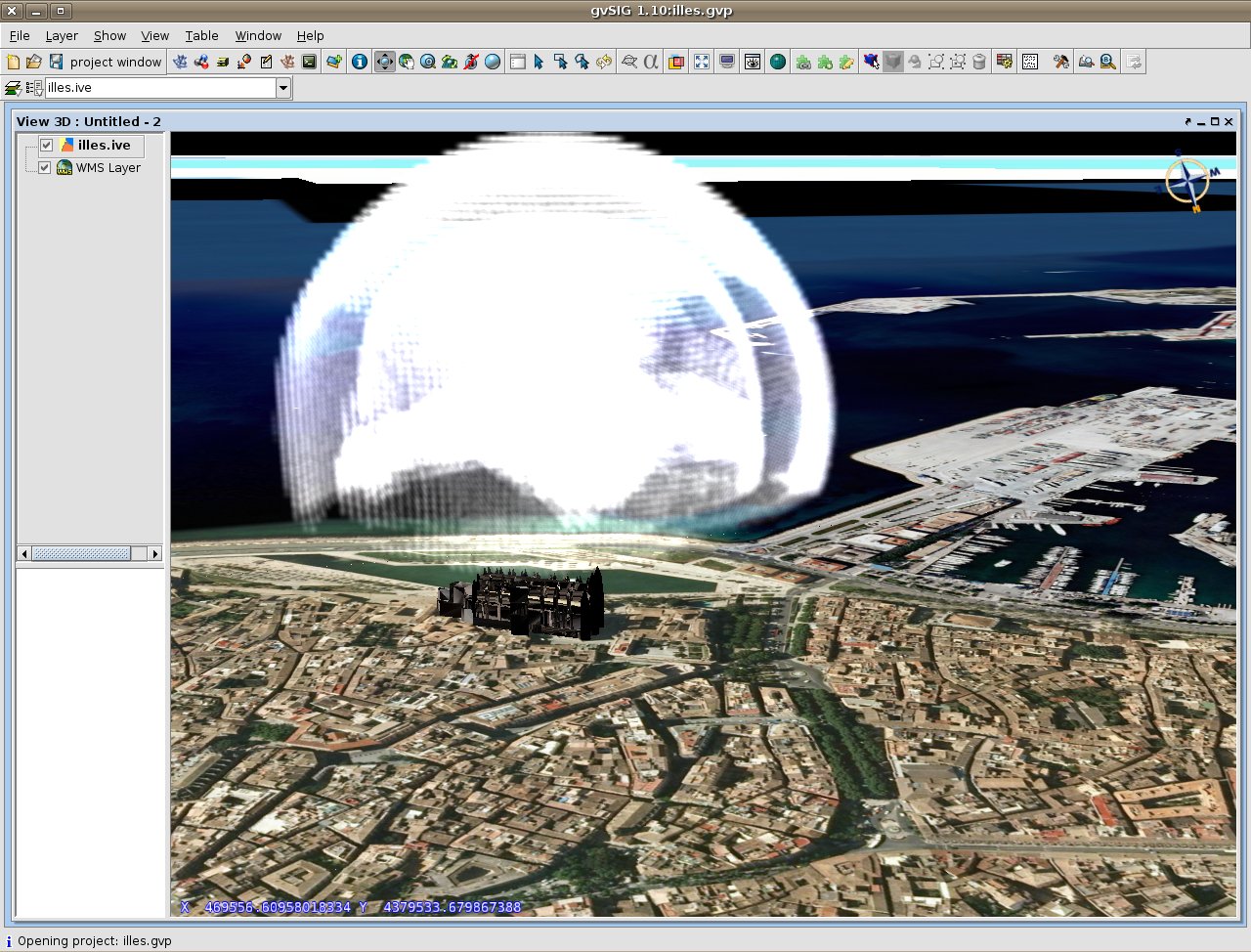
In the other hand Indra and UPM are working on building visualization and 3D visualization of athmospheric patterns related to air quality. They gave us this images. Every single 3D data is represented by a sphere, which color depends on the value of the data. 

Por otro lado Indra y la UPM están trabajando en la representación tridimensional de edificios y la visualización de datos 3D producidos por modelos atmosféricos y de calidad del aire. En este caso cada dato 3D viene representado por una esfera, cuyo color varia dependiendo del valor del dato. Nos han dado permiso para mostrar estas imágenes:


[1]http://www.cdti.es
[2]http://www.deimos-space.com
[3]http://www.indracompany.com/
[4]http://www.tid.es/
[5]http://www.upm.es/
[6]http://www.iac3.eu/

sábado, 14 de mayo de 2011

gvSIG 3D Team at "España Virtual" Workshop

English

This week we have been very busy attending to the "España Virtual" Workshop[1]. As many of you know this CENIT project supported by CDTI[2] and leaded by Deimos-Space[3], aims to push the state of the art of geomatic science in Spain. In the scope of this project we are developing hard in several lines of work. In this post you will be able to see a few videos of some of them.
  • Advanced Symbology: We added new render techniques to the osgVirtualPlanets library[4], the core of gvSIG 3D. These techniques let us to render new symbols with a quite good frame rate. In this video we show point sprites, particle systems and instanced rendering. We hope we can integrate these functionalities soon in gvSIG 3D. 
  • Multiresolution of vectorial data: One of the problems we have in the current version of gvSIG 3D is rendering big amount of vectorial data. Is a must to apply multiresolution techniques in order to avoid RAM memory problems and low frame rates.  This video shows a quite popular spatialization algorithm called Octree.  It could be very useful to render regular massive vectorial data, for example Lidar data.
  • Collaboration with a friend project, WebGLEarth[5] : This project enables exploration, zooming and “playing” with the globe in any web browser on any platform supporting webGL (like chrome 9[6] or firefox 4[7]). We are collaborating with them and we have implemented zoom and pan controls, and camera throwing. It is a very promising project.

Español

Esta semana hemos estado en el workshop del proyecto "España Virtual"[1]. Como muchos de vosotros sabeis, este proyecto CENIT iniciativa del CDTI[2] y liderado por Deimos-Space[3] pretende avanzar el estado del arte en el campo de la geomática en España. En el ámbito de este proyecto estamos trabajando duro en varias líneas. En este post podreis ver videos de algunas de ellas.
  • Simbología avanzada: Estamos trabajando en añadir nuevas técnicas de visualización en la librería osgVirtualPlanets[4], el núcleo de gvSIG 3D. Estas técnicas nos permitirán mejorar el tiempo de dibujado y añadir nuevos tipos de símbolos. En este video se muestran point sprites, sistemas de partículas e instanciación de geometría. Esperamos poder integrar estas funcionalidades pronto en gvSIG 3D. 
  • Multirresolución de datos vectoriales: uno de los problemas que tenemos en la actual versión de gvSIG 3D es visualizar grandes cantidades de información vectorial. Se deben aplicar algoritmos multirresolución para evitar problemas de visualización y memoria. En este video se muestra una técnica de espacialización de geometría bastante conocida, el Octree. Puede ser muy útil a la hora de representar cantidades masivas de datos vectoriales regulares, como por ejemplo los datos Lidar.
  • Colaboración con un proyecto amigo, WebGLEarth[5]: Este proyecto permite la visualización e interacción con un globo virtual en cualquier navegador y plataforma que soporte webGL (como chrome 9[6] o Firefox 4[7]). Nuestra colaboración hasta el momento ha consistido en la implementación de los controles de movimiento y el lanzamiento de cámara.


[1]http://www.españavirtual.org
[2]http://www.cdti.es
[3]http://www.deimos-space.com
[4]http://forge.osor.eu/projects/osgvp
[5]http://www.webglearth.org
[6]http://google.com/chrome
[7]http://www.mozilla.com/firefox/fx/

viernes, 1 de abril de 2011

gvSIG 3D - Final Version - codename "BladeRunner"!!


Español 

Hola replicantes ;) !!

Hoy es un día especial para nosotros...Después de cinco años de trabajo nos complace anunciaros la publicación de la versión final de gvSIG 3D disponible en [1]. También hemos publicado una versión para Mac OSX que incluye 3D disponible en [2].

Queremos agradecer toda la colaboración que hemos recibido de la comunidad de usuarios, cuya implicación en la fase de testing ha sido inmejorable y que incluso ha elegido el codename "BladeRunner" en una ajustada votación, curiosamente el nombre propuesto por el jefe... ;)

En esta ocasión también nos gustaría agradecer su trabajo a las personas que empezaron con nosotros este proyecto, en especial a Julio Campos, Ángel Fraile y Salvador Bayarri. También a Thibault Mousset y Eline Lachat, que nos acompañaron en un tramo del camino.

En mi ya larga trayectoria en la universidad, tengo que decir que una de las cosas de las que más orgulloso me siento, es de haber formado este grupo de trabajo, el cual demuestra día a día su capacidad de resolver todos los problemas que se les plantean. A pesar de todos los inconvenientes, en cuanto a financiación e incertidumbres que han surgido a  lo largo de este tiempo, el equipo ha sabido permanecer unido y ha hecho frente a todos los inconvenientes. Rafa, Jordi, María, Jesús, Leo y Jorge muchas gracias por vuestro trabajo.

A partir de este momento miramos de cara al futuro con la intención de seguir trabajando duro. Esperamos dar lo mejor de nosotros para que el proyecto mejore día a día.

Por último, también queremos agradecer a la Consellería de Infraestructuras y Transporte, en especial a Martín García y Gabriel Carrión,  por haber creído en nuestro potencial para el desarrollo de este proyecto y por extensión a toda la Asociación gvSIG.

Xavi Lluch

Responsable científico del proyecto y del Grupo de Informática Gráfica del Instituto de Automática e Informática Industrial.

English

Hi replicants ;) !!

Today is a special day for us... After five years of work we are glad to announce the release of the final version of gvSIG 3D!! It is available in [1], and the Mac OSX version in [2].

We appreciate the support provided by the user community, whose implication in the testing process has been extremely important. They also have chosen the codename "BladeRunner" in a very tight voting.

This time we'd also like to thank the people who started this project with us , specially to Julio Campos, Angel Fraile and Salvador Bayarri, as well as Thibault Mousset and Eline Lachat.  

One of the things that made me feel most proud of during my years in the university, has been starting this working group. Their members demonstrate day after day their capacity to solve problems. Despite the difficulties we had (mainly about financiation and uncertainty), the team remained very close: Rafa, Jordi, María, Jesús, Leo and Jorge thank you very much for your work.

From this moment we are looking to the future with the purpose of keep working hard. We hope to do our best in order to improve the project.

We'd like to thank the  "Consellería de Infraestructuras y Transporte", specially  Martín García and Gabriel Carrión, and also gvSIG Association for believing in our potential to develop this project. 

Xavi LLuch

Scientific project manager and Computer Graphics leader in the Instituto de Automática e Informática Industrial.


[1]http://forge.osor.eu/frs/?group_id=178&release_id=746
[2]http://forge.osor.eu/frs/download.php/1556/gvSIG-3D-1_11_0-RC1-1303mac-i586.dmg


viernes, 11 de marzo de 2011

gvSIG 3D - RC1 is here!!


Hola comunidad!

Tras pasar el plan de pruebas y arreglar los fallos encontrados por el equipo de testing estamos más que contentos de poder anunciar la versión RC1 de gvSIG 3D. Podeis descargarla desde aquí [1]. 

En esta ocasión nos gustaría dar las gracias en especial al equipo de testing de gvSIG. También a Álvaro Anguix por ayudarnos con temas no relacionados con el desarrollo, y a Joaquín José del Cerro, por sus acertados consejos.

Si no se encuentran errores graves ésta pasará a ser la versión final!

Por cierto, acordaos de votar en la encuesta para el codename de la versión final. La votación está más que ajustada!!

Hi community!

We are very happy to announce the RC1 version for gvSIG 3D available in [1].  

This time we'd like to thank specially the gvSIG testing team. Also to Álvaro Anguix, for helping us with non-development related stuff, and to Joaquín José del Cerro for his suggestions.

If there aren't critical errors we will tag this version as final!

By the way, we want to encourage you to vote for the final version codename in the poll, just at the right column of this blog. Right now the voting is very tight! 


[1]http://forge.osor.eu/frs/?group_id=178&release_id=718

jueves, 3 de marzo de 2011

New build of gvSIG 3D (number 19) -- Codename "HANNIBAL"


Español

Desde el equipo de gvSIG 3D nos complace anunciar un nuevo build de gvSIG 3D que podéis descargar desde [1]. Este build ha sido posible, gracias al apoyo que la comunidad de usuarios y desarrolladores ha demostrado.

Nos gustaría agradecer el trabajo realizado por el equipo de testing de gvSIG: Manuel Madrid, Núria Fora, y Juan José Martí. Gracias por vuestro interés!

Algunas de las mejoras más importantes son:

* Solucionado problema de generación de texturas en tarjetas ATI.
* Solucionado problema con sistemas operativos linux 64 bit y drivers de gráficos.
* Solucionado problema con el instalador y java 1.5
* Añadidas cadenas de traducción al inglés que faltaban.
* Mejoras en el instalador de linux, comprobación de requisitos mínimos.

Esperamos que con este nuevo build continuéis dándonos sugerencias y reportando problemas para poder seguir mejorando.

Conviene recordar que las versiones en desarrollo están orientadas a que los usuarios puedan evaluar y testear las nuevas funcionalidades de gvSIG, pero no son versiones que deban ser usadas en entornos de producción.

Por otro lado queremos animaros a votar en la encuesta que hay situada a la derecha, para elegir un codename para la versión final. ¡Por ahora la votación está bastante apretada!

English

We are pleased to announce a new build of gvSIG3D available in [1]. This development has been possible thanks to, especially, the community support.

This time we'd like to thank the gvSIG testing team: Manuel Madrid, Núria Fora and Juan José Martí . Thank you for your interest!

Among the new features, we shall emphasize:
*Fixed texture problems in ATI cards.
* Fixed problem with 64 bit and graphic drivers.
* Fixed installer for java 1.5
* Fixed  missing english strings
* Improvements in linux installer, cheking for minimum requirements.

We encourage everyone to try this version and await your comments and suggestions in the blog as well as in the mailing list in order to keep improving the framework.

These development versions are oriented to test and evaluate new functionalities of gvSIG, so it's not recommended to use it in a production environment.

By the way, we want to encourage you to vote for the final version codename in the poll, just at the right column of this blog. By now the voting is very tight! 


[1]https://gvsig.org/web/projects/gvsig-desktop/devel/gvsig-3d

martes, 1 de marzo de 2011

OpenSceneGraph running on Android


Español:

Buenas, mi nombre es Jorge Izquierdo y acabo de incorporarme al equipo del ai2. Desde que entré he estado trabajando en una manera de utilizar la librería OpenSceneGraph en Android. Después de un tiempo de trabajo y revisión podemos presentar la primera versión para la cadena de compilación con Cmake/Android ndk así como un ejemplo en video.

De momento se soportan las características básicas de OSG. Sin embargo debe tomarse esta compilación como experimental y algunas características podrían fallar. Se sabe que multithreading y los serializadores de osgSim y osgShadow no funcionan correctamente. Además los wrappers marcados como deprecated en OSG no han sido incluidos en la compilación.

Las pruebas realizadas han sido hechas con Android 2.2.1 y 2.3 en una Archos Tablet 70 IT y un HTC nexus one y la librería OSG configurada para OpenGL ES 1.1. Los requisitos mínimos son Ndk r4 (Crystax)/Ndk r5 y Android 2.0. Actualmente se compila toda la librería, plugins, etc, en estático.

Seguiremos informando!

English:

Hello, my name is Jorge Izquierdo and I'm a new member of ai2 team. Since I joined the team I've been working in a way to get running OSG on Android. After some time of coding, and code refactoring we can show our very first version of a building toolchain for CMake/Android NDK and a working test example.

Right now basic OSG features are supported. But this can't be taken as a "fully" functional compilation. It's a experimental building and some features could crash without any warning. We know that multithreading and osgSim, osgShadow serializers are not supported. Deprecated wrappers have not been included in the build or the test example.

Testing was made on Android 2.2.1 and 2.3, on Archos Tablet 70 IT and HTC Nexus One respectively, with OSG configured to draw using OpenGL ES 1.1. Minimum specs are NDK r4 (Crystax)/NDK r5 and Android 2.0. The entire library and plugins are compiled in a static way.

We will keep you up to date!